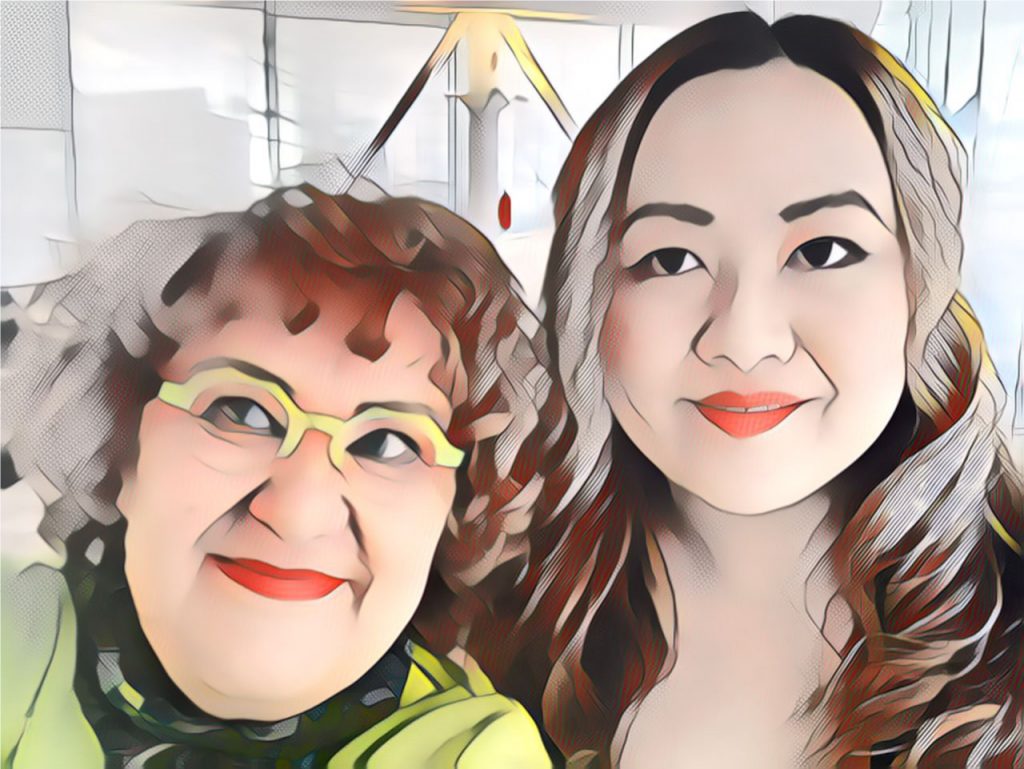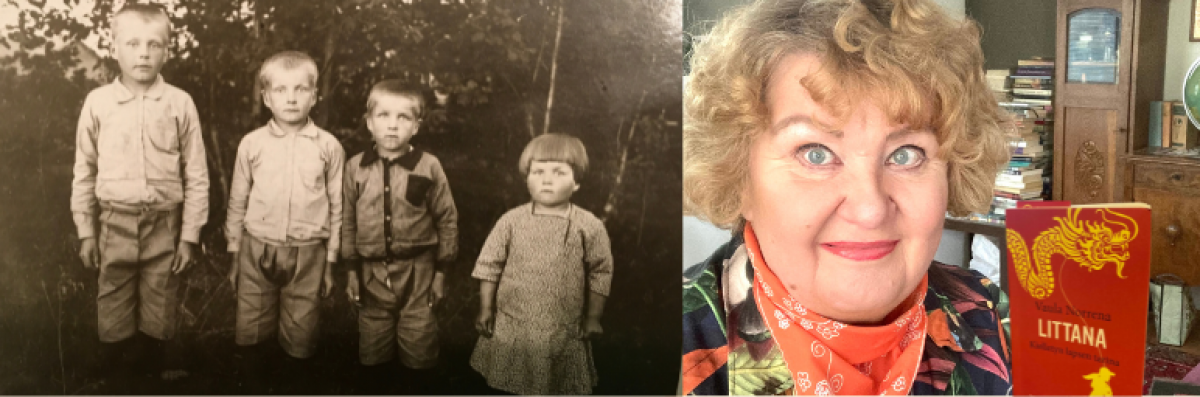
Littana – Flatty has aroused such interest, that I think it’s time to give you some excerpts of the book in English. The translation is mine, so it’s not perfect, however you surely get the main idea and tone of the book.

At first, this is how the publisher has introduced the book.
Story from a broken history
Littana – Flatty is the true story of a girl born as a forbidden child in China in 1989.
Forbidden because of China’s one-child policy and because there was already a first daughter in the family.
The family wanted to have a son as well, as male children were considered of unparalleled value in Chinese families at the time. But the second child was born a girl, too.
The consequences for both the family and little Pingping were severe.
A fine the size of three years’ wages was put on the family. The whole village scorned and despised both the child and her mother. Pingping was more or less disdained in her own family, because she had caused so much trouble by being born a girl.
The family moved to Finland when the girl was 5 years old. She soon learned Finnish and at the age of 7 she was already used as a child interpreter for her parents and their friends at different offices and medical services. She also worked regularly as a child labourer in the family’s restaurant since the age of 9.
Growing up, she struggled with her identity in the crossfire of two very different cultures, while suffering from tensions within the family, too.
Over time, she grew up to become Jenni Chen-Ye, a determined and enterprising, now 34-year old woman who found her place in Finnish society despite the hardships she went through.
Littana – Flatty is an intact, moving and gripping story of a broken history. It is an important and topical story about the role of immigrant children and the encounter of different cultures.
CONTENTS OF THE BOOK
- For you
- For the beginning
- I HAD TO BE A BOY
- Let’s make a boy
- Forbidden child
- One Child Policy
- How did you lose your willy?
- School and stick
- To a new homeland
- In a Finnish school
- II AS A CHILD INTERPRETER AND RESTAURANT ASSISTANT
- Child interpreter at the doctor’s and police station
- From district court to miscarriage
- Immigration policy in Finland in the 1990s
- Restaurant work
- The UN Convention on the Rights of the Child
- A sale of two thousand marks
- A restaurant deal and lost lunch vouchers
- The good child ’xiào’
- Confucian values
- III UNDER A SISTERLY STRIFE
- The Big Sister
- The Spice Girls and the piano
- Music class outcast
- Children of foreign origin at school
- Back to Kontula
- Fighting little mothers
- IV I WANT OUT OF THE FAMILY
- A trip to China
- Grandmother’s memoirs
- Hard-hearted China
- From cultural revolution to economic powerhouse
- A new name
- Music is banned
- Criminal complaint
- Wenle
- A painful choice
- Another trip to China
- In therapy
- V LIFE IN MY OWN HANDS
- First restaurant
- Son and daughter
- Politics and the Chinese Association
- Corona knocks over restaurants
- What I think about everything now
- Author’s afterword and thanks
- About the Chinese sentences
- Sources and reading

EXTRACTS FROM LITTANA – FLATTY
From Chapter 2: Forbidden Child
”Finally my mother went into labour and her contractions started at my aunt’s house in Huobang. It was the first weekend of June and the time of the new moon, the signs in the sky were favourable. My father and his relatives had come to the scene to celebrate the birth of the new baby. The men were rushed out of the house to wait. There they joked in circle, smoked cigarettes and, in a mood of enthusiastic excitement, tasted a little drink as well.
– Soon you too, Jianhua, will become a real man! Father of a baby with a willie! encouraged Jianhua’s older brother, the one who already had a son.
The other brother, who had been fated to have three girls, blustered:
– ”First one and then another boy, Jianhua will bring it home!
For once, there was a warm atmosphere of solidarity between the rival brothers.
Inside the house, the pain of childbirth was intense. The summer of 1989 was stiflingly hot and hygiene in the village without running water was what it was. An old midwife had been called in, experienced but not trained as a midwife.
The birth lasted all day on Sunday, but in the end it went well, from a health point of view. As the clock approached midnight, the baby came out of the womb – a healthy, brisk, chubby-cheeked, black-haired baby!
Then the triumphant faces of the women in the delivery room turned serious.
The baby was not a boy after all. The forbidden second child was a girl. Another girl.
Disappointment swept through the room like a death knell. No one said anything.
The women dared not tell the men these news, but when the old nanny came quietly out of the delivery room, the men realised that the child had been born. My father rushed into the house, shouting in a high-pitched voice:
Is there a WILLY??! Is there a WILLY or is it a FLATTY?
No one answered.
– Can I go and see? he asked the midwife in a frenzy.
The old woman, her cheeks furrowed, nodded gravely without saying anything.
My father immediately ran to my mother, who was exhausted from childbirth. My mother looked at him with a frightened expression, baby wrapped in a blanket in her arms. But my father, in his eagerness, did not notice her anxious face. He ripped the naked newborn from under the blanket and was stunned.
– FLATTY! You got a FLATTY again?” he gasped, disbelieving and angry.
He stood for a moment at the bedside, perplexed, and then disappointment took over.
– Pie Me! Cunt kid! It was supposed to be a BOY! he snarled and walked away.
Outside, the men fell silent, shoulders slumped in disillusion, and no one could say anything more.
Now the families of my father Jianhua and my mother Guilan were in real trouble. If the second child had been a boy, it would have been possible to bribe the village authorities to issue him with a hukou, a birth certificate, and thus give him the right to go to school and live as a member of society.
But as the banned baby was a girl, the child had no chance. She had to be either eliminated, given away or concealed. That baby was me, Chen Pingping.”
……… Extract translated from Littana – Kielletyn lapsen tarina.
Copyright: Vaula Norrena, publisher Teos kustantamo in Finland 2023.
From chapter 3: How did you lose your willy?
”I have very early memories of being questioned by relatives over and over again:
– Where’s your willy? You were supposed to have a willie, where has it gone?
Whenever we went to someone’s house in the village, the horseplay would start.
– It would be perfect if you had a willie – where have you lost it?
The uncles laughed, grabbed my arm, squeezed it hard with their rough claws and demanded an explanation.
– Your mother gave birth to you to have a son, why are you such a flatty?
The aunts pounded some more. My mother joined in, she could shout from the kitchen while she was cooking:
– Shall we make Pingping a wiener out of dough? Let’s make a fake willy and bake it in the oven, would that work?
Then everyone bursted into rough laughter. The joke might have been funny to the adults, but as a little girl it really distressed me. Even at the age of two, I had to make excuses to my uncles and aunts why I didn’t have a wiener.
One of my strongest stories was that I originally did have my wee-wee still in my mum’s tummy, but it came off when I was fighting with my big sister and she kicked it off and was the first to rush out of mum’s tummy. The adults always laughed at this and probed me some more. And I had to make more up.
Therefore, some relatives started calling me Pingdiaou, the ’diaou’ in it means falling, disappearing, falling off.
This kicking story had a basis in reality, in that my big sister was used to kick me and beat me with her fists or pinch me painfully whenever the adult eye was avoided. She didn’t approve of her little sister then – or, as a matter of fact, any later, either.
In the role of a boy
As a child, my mother dressed me in boys’ clothes and cut me a short boy’s hair. Boys’ shirts and trousers were given to me by cousins from my father’s side.
My hair was plucked with long fabric scissors into a vague short ringlet that sticked out until it grew a little and started to fall behind my ears – and then it was cut again. My mother used to do this even when I was older and at school.
She also required me to be a brave boy: unlike my big sister, I wasn’t allowed to cry when feeling down or sad.
My mother used to give me boys’ toys and boys’ books, whereas my sister got all sorts of princess stuff. Once she bought my sister a ’Nine Princesses Book’, that had nine different beautiful princesses with gorgeous costumes and jewellery in all kinds of parties and dancing balls.
For me she brought the ”Pumpkin Brothers” book (Huluwa brothers), with seven boys just fighting around. Luckily, each of the Pumpkin Brothers had some kind of superpower, so with their help I could imagine which magic power I wished to get and how I would then fare against my sister and cousins in our fights.
My big sister had her hair grown long and combed into a fancy combover, her head stuffed with decorative pins and bobbles. But my hair was plucked so that you couldn’t put a single pin or bow. My big sister was bought fancy frilly dresses, whereas I was allowed to inherit my cousins’ old trousers and shirts.
Strange. Did Mum want a boy so badly that she had to force me to be a boy?
Or was she trying in some way to cover up the mistake of giving birth to two girls; that her second, forbidden child was not a boy, but a girl? Or was he ashamed of me as a girl and tried to disguise me as a boy?
There were constant misunderstandings about my boyishness: I was really mistaken for a boy everywhere I went. When we went to any stranger market in some neighbouring town, the vendors mistook me for a boy and complimented my mother:
– How lucky you are, madam, to have two such fine children, a girl and a BOY!
The ”boy” was always pronounced in a particularly exultant, loud and high-pitched voice.
My mother just nodded with a pious smile and did not correct the mistake. I knew from a very young age, probably from the very beginning, to keep wisely silent at that point.
If, on the other hand, the market vendor asked directly ”is that other child a boy or a girl?” and my mother had to answer in a whisper ”it’s a girl too”, the vendor would scream loudly:
– REALLY!? What a MISFORTUNE there!
Someone would continue without further ado: – And how much was your penalty ticket?!?
Then the whole market began to moan and lament loudly about my mother’s fate, because I had been born a girl, and there was no way of getting rid of me, and I had even come to cost my family a fortune.
Thus I learned the hard way that while my older sister was admired for her long hair and pretty girlish features, my girlhood was a curse and a disgrace to the whole family.
I was too small to understand and question why exactly my girlhood was a bad thing. I only knew that I was a failed, distorted and a bad child.
……………..
I adopted the age-old ideal of the disciplined and humble boy of Confucius. In a book that was read to us in Chinese school, it was described like this:
One day Mr. Guo Gang’s son was disobedient and did not do the tasks his father had assigned him. His father got angry and gave his son 100 whacks of a stick on the back. The boy fell under the blows without flinching or making a single sound of crying, even though blood flowed from the wounds and the bruises and contusions swelled.
The next morning the boy crawled on all fours before his father, bowed his forehead to the floor and apologised: ’My high father, I humbly apologise for causing you pain and disappointment. I apologise that your shoulder is now sore because you had to give me a hundred strokes of the cane’.
In Western culture, the boy’s last sentence would be understood as a retaliatory retort, but in China, at least as late as the 1990s, the story’s child’s extreme humility, resilience in enduring a beating and even more thoughtful understanding of his father’s beating woes were admired.
A brave boy does not cry even when he is not accepted to play with others. A brave boy can manage on his own. A brave boy pretends that nothing has happened, even with his head under his arm. A brave boy doesn’t complain even if he gets a cut on his leg or a stomachache.”
…… Extract translated from Littana – Kielletyn lapsen tarina.
Copyright: Vaula Norrena, publisher Teos kustantamo in Finland 2023.
From Chapter 8: From the district court to a miscarriage
”Over the years, we became familiar with a wide range of adult services and authorities in Finland. We served as interpreters and form fillers for my parents and their friends even in sensitive matters, such as at the doctor’s, at the social services, at the lawyer’s office, or even when they were seeking a job.
Once I ended up with a family friend to help him sort out a divorce petition that both husband and wife wanted to file. They were a fine family: hard-working, decent people, but hard fighters. The young Chinese wife had arrived in Finland many years after the husband and, as a housewife, was suffering from loneliness. Her lack of language skills meant that she had no other adult contacts, not even at the children’s playground. This frustrated her and caused friction at home.
Every now and then, my father and mother would find themselves softening the couple’s relations in some heated argument, which after a few days was forgotten and life went on as before. But this time it was for real. Mr Luan Heping and his young wife wanted a divorce.
– Now let’s go to the registry office and put an end to this torment! Mr. Luan came to the restaurant to deliver to my father.
– If that is indeed the case, go ahead, take Pingping with you, she can fill in the papers, my father said calmly, convinced that the divorce petition would be soon withdrawn anyway.
I dutifully accompanied Mr Luan to the district court. He was an old acquaintance of mine from years ago, so I was not nervous to go with him. On the subway ride, he asked:
– What do you have to put on those papers?
I thought for a moment, I had never filled out such forms, so I had to guess.
– I guess they put your name, address and ID number, as they do on all applications.
– And maybe the reason why you want to divorce, it occurred to me having heard in some movie.
– Reason! Do I need a reason to get rid of that lopsided woman! I’ve put up with her whims for long enough, I’ve had enough! Mr. Luan foamed, as if he were talking to my father.
– Let’s put down ”the lopsided wife” and ”the whimsy” as the reason, I suggested. I tried to be helpful and useful with all the wisdom of an 11-year-old.
– Well, at least not for adultery, reasoned Mr Luan, that’s not the case anyway. I wonder what they usually do.
– I can ask the clerk.
– That’s a good idea, ask!
When we got to the district court, the tight-bunned clerk lady looked at us very disapprovingly over her glasses and shoved the divorce forms in front of us without explaining anything. We retreated to a small table behind to wonder what this long and vast flyspeck of paperwork meant.
It turned out that there was no need to state any grounds for divorce in the application, but a whole bunch of claims about the children had to be filled in. The forms also asked whether the spouses were applying for divorce jointly or separately.
– Jointly? I’m not doing anything together with that nutcase anymore! Luan Heping was still frenzying on.
– What about this child thing, do either of you have any claims on the child, custody, housing or other arrangements, they ask, I read from the form and translated into Chinese.
– My wife can take care of the child, but of course I want to see the child whenever I want, said Mr Luan.
– Okay, let’s write that down, I said, and scribbled in my child’s handwriting on the part of the form where there was a bigger box for explanations: “The wife can take care of the child, but the husband can see the child whenever he wants”.
When we got to the counter, the clerk glanced through the papers with her old-fashioned, thick-lensed glasses and said to me in a blunt tone:
– However this is not enough. If this man is not filing for divorce jointly with his wife, the wife’s consent must be obtained for childcare issues – which can be handled separately outside the court, for example by a children’s guardian.
I explained this as best I could to Mr Luan. We pondered for a while what to do. We decided that we would not leave the child documents now, since we didn’t have the needed mutual agreement with the wife. That would have to be sorted out later with the children’s guardian, and we would first have to find out what office that was, where it was located and how we could possibly get there.
We were missing a lot of necessary details. I would have to tramp around with Mr Luan in who knows how many places, I thought to myself. As we left the office, I told him as politely and soothingly as possible:
– I’m sorry, Mr Luan, that we couldn’t get this done. We were not lucky this time. Yun qi bu hao, we had no luck.
But maybe we had. Because after a few weeks, the dust had settled on the marital dispute and the couple no longer wanted a divorce.
Months passed, almost a year, and the subject was not revisited. Much later, when I was already on summer break from school, this couple called us at home unexpectedly in the middle of the day. Could I go with them, just to take care of a quick official matter? They were old family friends, so I didn’t have to ask permission from my mom and dad, who were at work.
The couple came to pick me up in their car, wearing nice clothes, somewhat excited. Then we drove to Helsinki and ended up in the district court building again. It was only when we arrived at the counter that Mrs Luan turned to me and suddenly said in an agitated tone:
– Fill in the divorce papers for us!
I was now 12 years old and understood the seriousness of the matter. I had also seen how that family used to scuffle and then reconcile after a while. I understood my responsibility.
– I can’t do that to you, I replied.
– Just fill it in, because we both want it, Mr Luan said.
– I can not.
– Come on, we want a divorce! shouted the lady, already in a state of anxiety, and grabbed me firmly by the wrist. I instinctively began to tear my hand away and defended myself even more firmly: – I won’t. I can’t.
This argument went on for a while and then they gave up. I guess they didn’t have the heart to force me.
After some time, however, they did get a divorce, she found a new husband, but then again, after a few years, they got back together again. I wondered, as a curious teenage girl, whether it was a burning passion or the fate of two souls touching one another, unable to live together or apart.
……Extract translated from Littana – Kielletyn lapsen tarina.
Copyright: Vaula Norrena, publisher Teos kustantamo in Finland 2023.
From chapter 12 Good Child ‘Xiào’
”I have already explained how in Chinese culture, parents own their children (and grandchildren and so on for generations to come) and how children should be, above all, useful and obedient to their parents. It is their indispensable duty.
Chinese law contains 18 different articles of xiào, which list all the ways in which children should respect and serve their parents throughout their lives.
Among other things, the law specifies how children have a duty to support their parents financially and to help and protect their parents. In the old days, the law also stated that if a person did not act in a xiào manner towards their parents, it was such a crime, that the parent was allowed to even kill their child.
In xiào thought, parents are likened to a god, the creator of life. Throughout his life, a Chinese child owes a debt of gratitude to his parents for the kindness they showed by giving birth to him and feeding him when he was a small child. In return for being born and raised, the child must obey his parents even as an adult, work hard and give his money and skills to the benefit of his parents and grandparents as much as possible.
It goes without saying that no major or minor decision in life will be made by a good xiào child without first consulting his parents and grandparents. This is how a father and mother, grandfather and grandmother, control the life of an adult child. They may choose a job for you, a spouse, a place to live, everything. This still happens in rural areas, but of course not so much in cities, anymore.
Children remain in close family ties even after they have grown up and married. As a young couple, they usually live with the man’s parents and they often work in the same job or family business with their relatives.
In China, the xiào principle permeates the whole of society, so that the ruler and the administrative apparatus are also likened to the creator of life, the father of the country, whose will the family, the people, must respect without question or questioning.
Girls do not have the same opportunities to be xiào as boys, especially in rural areas. A boy child brings 40 more units of land to a rural family at birth, but a girl brings nothing.
The law has been like that for centuries (except during the most intense years of communism, when farmland was treated as common property). Boys also tend to stay in their own families as adults, but girls have to be handed over to work in their husband’s family. Therefore, girls are considered to be only a cost of living and not a benefit to the family.
If Chinese parents feel that one day or in some situation the children are not useful enough, they exclaim ”Bai yang le! Then why did we give birth to you! We supported you in vain!” or ”Mei you yong! You are useless!”, and that is a bad accusation indeed.
I think the Chinese custom is to keep children and subjects humble by frequently berating them. Still, although mothers and fathers hardly ever praise or thank children directly, they can get into quite a rant with other parents when discussing their children.
– My child scores straight A’s on tests!
– My child got into the Top One High School!
– My daughters ran the restaurant all by themselves during their school holidays!
– My adult son brings home a sack of money every month so we can send money to China, now there you’ve got a good child xiào!
You hear a lot of this kind of talk especially at Chinese New Year celebrations, when casual acquaintances catch up with each other’s news.
Children, boys and girls alike, who have emigrated abroad can support an entire family in China, including grandparents, uncles, aunts and nephews, if the family happens to live in a poor rural area. Fortunately, the Chinese are a hard-working people and can put in long days to be xiào and pay their debt to the family that gave birth to them, and that debt seems never-ending. Even when I was a little girl of 10, I was asked by my relatives:
– Will you help us when you grow up? You shall sure send your aunt money when you grow up and start working as an adult, won’t you?
– You’ll look after your relatives when you get a good job in the West, won’t you?
In rural China, the West is still seen as an Eldorado, where everything is gold-plated and money rains down from heaven on hard-working and good guest workers, whose greatest honour is to send money home to China.
Fortunately, my parents were not alone in responding to the demands of the Haikou families. There were several of my father’s sisters and brothers in Sweden, and in the course of time some Chinese family members came also to Finland to work in our restaurant.
It was a hard job for my parents to pay debts and aid to the Chinese family at the same time as they had to pay the debts and expenses of their own restaurant. So we lived in a small rented flat for years and years, even when my parents were already doing quite well.”
……Extract translated from Littana – Kielletyn lapsen tarina.
Copyright: Vaula Norrena, publisher Teos kustantamo in Finland 2023.
CHINA’S ONE CHILD POLICY
EXAMPLE OF AN INFORMATION BOX IN THE BOOK
Extract translated from Littana – Kielletyn lapsen tarina.
”China’s one-child policy was launched in 1979. The reason was that the population of the populous country was growing too fast. Under Mao Zedong, China’s population had almost doubled in 25 years from 560 million to 940 million. Before the one-child policy, women had an average of nearly six children in their lifetime: easily nine in rural areas and three in urban areas. The whole culture was family-oriented and in rural areas children were needed for work.
When Mao died in 1976, China was led by Deng Xiaoping, who wanted, above all, to improve the country’s economy quickly. The high number of children and the resulting high education and pension costs were an obstacle to the country’s prosperity in the eyes of the new leadership.
The Communist Party decided to radically limit the number of children to one per family.
Family planning agencies were set up to control the quotas of children allocated to each region. The regions were broken up into ever smaller districts. Eventually, there were authorities in every block to keep an eye out for overpopulation.
Couples had to apply for permission to have a child even before they became pregnant. If the district quota was in danger of being exceeded, no permission was granted. The central management would punish local authorities if the quota was not met and reward districts that managed to go below the quota. Women were forced to have abortions if the village quota was in danger of being exceeded or if they already had a child. Women were also forcibly sterilised and might have their babies taken away if they did not comply with the one-child rule.
With the strong value placed on male children in Chinese culture, the one-child policy meant that girl babies may even have been secretly eliminated at birth. Millions of baby girls were eliminated by suffocation or drowning during those years. Or left by the side of the road to be cared for by fate.
In rural areas, the population rebelled against the new policies. In their peasant way of life, children, especially boys, were an indispensable source of labour and old age security. In the countryside, skirmishes broke out between citizens and authorities. Many forms of corruption also developed to circumvent the one-child policy.
Later, from the late 1990s onwards, in rural areas, one was allowed to have a second child if the first was a girl. A second child was also allowed if the first was disabled.
In the 2000s, there was an awakening to the fact that there were no spouses for the new, large group of young men, as families had succeeded in having sons as their only children. By the 2010s at the latest, it was recognised that China’s dependency ratio was about to be turned on its head. In the future, a huge number of elderly people would be supported and cared for by far too small a generation of young people.
It is estimated that around 400 million children were left not born in China under the one-child policy. According to official statistics, there are 13 million children born as illegal second, third or fourth children in China under the one-child policy, but there are probably more.
Paradoxically, although the one-child policy eliminated quite a few girl babies, those girls who were allowed to be born as only children were much better off. Most of them were allowed to go to school and develop themselves. When they grew up, they were sought-after spouses in a market of scarcity, where for every 100 young women there were 120 young men. They also ranked higher in the workforce than women of previous generations.
In this way, the one-child policy also led to greater equality for women in China.
China abolished the one-child policy in 2016, allowing families to start having two children. But Chinese people were already so used to the one-child system that many no longer wanted more children.
In 2021, China’s Communist Party Central Committee made a historic decision: the country will switch to a three-child policy. This is an attempt to correct the skewed age distribution of the population and raise new generations to care for a large and valued elderly population.
The abolition of the entire child limit is now being publicly discussed in China, as young people are needed and the country’s rapidly growing prosperity would allow for a good life for larger families.”
Sources of this information box:
Tiina Airaksinen et al: Enemmän kuin puoli taivasta (More than Half a Heaven, the History of Chinese women)
Kay Ann Johnson: China’s Hidden Children.
Xinran: China’s Hidden Daughters.
Jeffrey N. Wasserstrom: China in the 21st Century.
SIlja Keva et al: Dragon, Tiger and Chrysanthemum.
Mari Manninen: Yhden lapsen kansa (Secrets ans Siblings)
China National Bureau of Statistics.
Copyright: Vaula Norrena, publisher Teos kustantamo in Finland 2023.
Thank you for reading!